
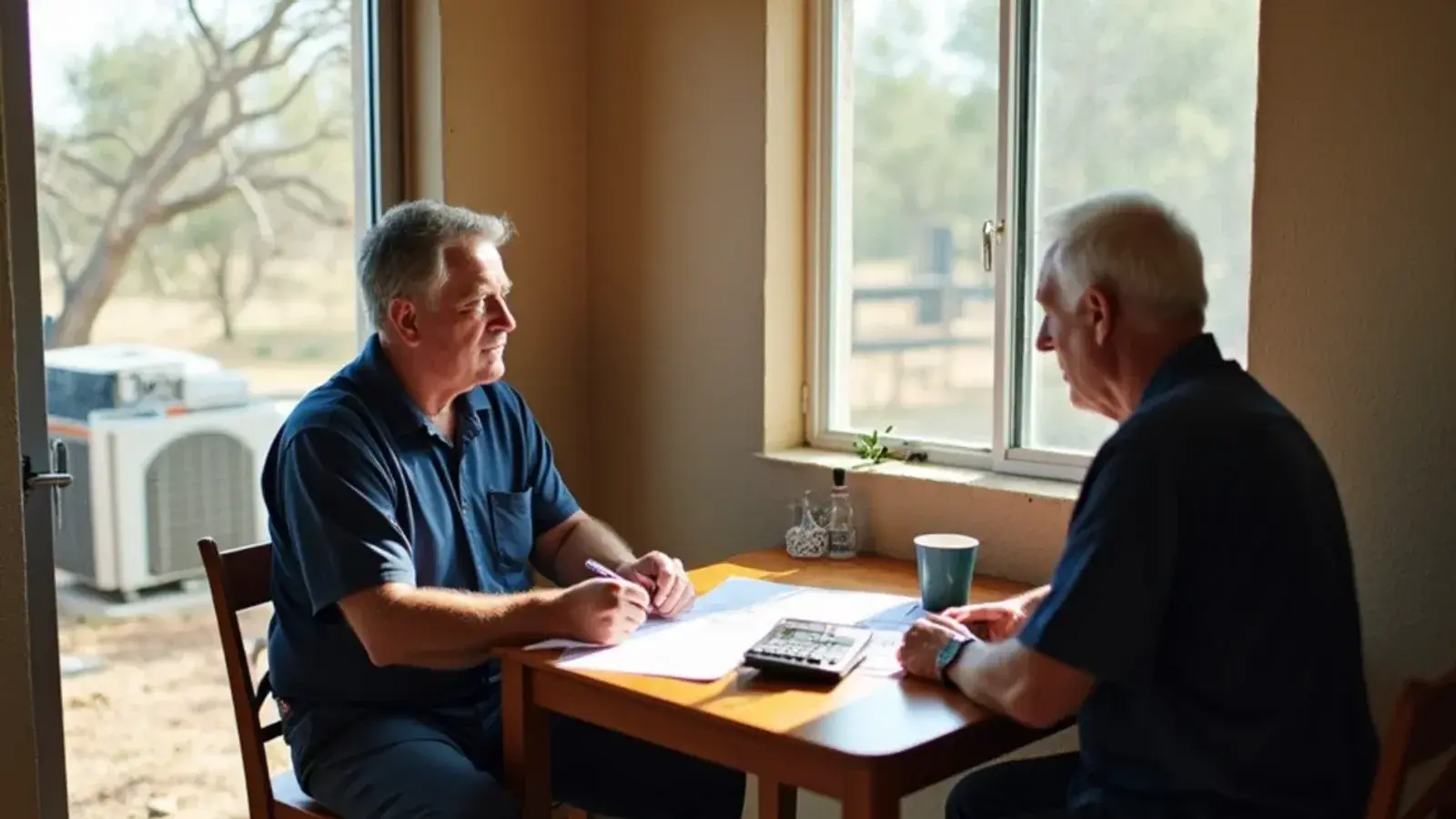
AC financing options in Rio Grande City come down to four routes: a lender arranged through the contractor, a loan from your bank or credit union, a credit card, or home equity. Compare them on the total you will repay, whether promotional interest is deferred or waived, and any fees, not on the monthly payment.
When a system fails in the middle of a Starr County summer, the first question is often how to pay for it. Understanding those options before you sign anything is the best way to avoid a payment that looks small each month but costs far more in the end. This guide explains the common types of HVAC financing, what to compare across offers, and how to budget for a new central AC or mini-split.
We are not a lender and cannot give financial advice. What we can do is explain how these offers usually work and what to ask, so you can make the decision with your own budget and, if needed, a trusted adviser.
The main ways people pay over time
Contractor-arranged financing
Many HVAC companies partner with a third-party lender. You apply through the contractor, but the loan is between you and the lender. These programs often advertise promotional terms. The convenience is real; so is the need to read the details.
Your bank or a local credit union
Here you borrow directly, through a personal or home improvement loan, before the job starts. You pay the contractor as a cash customer. Credit unions in particular may offer straightforward terms to existing members, and you already know who you are dealing with.
Credit cards
Using a card works for smaller jobs such as a single mini-split or a major repair. Standard card interest is typically high, so this route makes most sense if you can pay the balance quickly or have a promotional card offer with clear terms.
Home equity
A home equity loan or line of credit uses your house as collateral. It can make sense for large projects, but missing payments puts the home at risk. Talk to a lender and a financial adviser before going this way for an AC purchase.
Reading a promotional offer
Promotional HVAC financing offers usually fall into two families, and they behave very differently.
| Offer type | How it usually works | What to watch for |
|---|---|---|
| Deferred interest ("no interest if paid in full") | Interest builds in the background during the promo period | If any balance remains when the promo ends, interest may be charged back to the purchase date |
| Reduced or zero interest | A lower rate applies for a set period or the full term | What the rate becomes after the period, and any fees added to the loan |
| Fixed-payment installment loan | Same payment each month until paid off | Total repaid over the full term, prepayment rules |
| Revolving credit account | Works like a store card that can be reused | Minimum payments that never clear the balance during a promo |

The deferred-interest structure is where many people get caught. The Consumer Financial Protection Bureau has pointed out that the small word "if" in an offer worded as no interest if paid in full is the signal that interest is building in the background, while a true zero-rate offer states an introductory rate instead. Paying only the minimum often leaves a balance at the end of the promotional window. Divide the financed amount by the number of promotional months and pay at least that each month if you want to avoid the back-charge.
Questions to ask before you sign
Write these down and ask them of the contractor and the lender:
- Who is the lender, and who will I be making payments to?
- Is the interest deferred or waived during the promotion?
- What is the total amount I will repay if I make only the required payments?
- Is there a fee to open the account, or a fee built into the price?
- Is there a penalty for paying it off early?
- Does applying involve a soft or hard credit check?
- What happens to the account if I sell the house?
- Is the cash price the same as the financed price?
Get answers in writing. A contractor who is confident in the offer will not mind.
Budgeting for the project itself
Financing works best when the system being financed is the right one. Start with an itemized quote. Our guide on AC installation explains what goes into a complete job, including the coil, copper lines, pad and thermostat.
| Budget step | Why it matters |
|---|---|
| Get two itemized quotes for the same scope | Prevents financing a bid that leaves out ducts, pad or electrical work |
| Ask about two efficiency levels | Shows how a higher-efficiency unit changes both the payment and the power bill |
| Set the monthly payment against your current budget | Avoids taking on a payment that crowds out other bills |
| Plan to pay off any promo before it ends | Avoids deferred-interest charges |
| Keep a little set aside for maintenance | Protects the warranty and the investment |

Settle the repair-or-replace question before the money question
From the equipment side, the most expensive financing mistake is paying over time for the wrong job. A few things are worth pinning down with the technician before any application goes in.
- Is replacement really needed? A failed capacitor, contactor or fan motor is a straightforward AC repair, even on an older system. A burned-out compressor, a leak inside the indoor coil, or an R-22 system that needs refrigerant are the situations where replacement usually makes more sense. Ask what was tested and what the readings showed.
- Can a repair bridge the gap? When a system fails in July but the cause is repairable, fixing it can carry the house through summer and leave time to compare quotes and lenders in the fall. A technician should tell you honestly when a repair is a sensible bridge and when it is money spent on a system that is about to fail again.
- Is the scope locked? Apply for the amount on a complete, itemized quote. If ducts, the pad or electrical work turn up later, the financed amount may not cover them.
- Is the size right? An oversized system costs more to buy, which means a larger amount financed, and it controls humidity worse. A load calculation protects the budget as well as the comfort.
- Who registers the warranty? Many manufacturers require registration within a set window after installation to give the full parts coverage. Make sure it happens, because a financed system with a lapsed warranty is a poor combination.
Help that is not a loan: Texas assistance programs
Some households qualify for help that does not need to be repaid. The Texas Department of Housing and Community Affairs (TDHCA) runs the Weatherization Assistance Program, which can include repair or replacement of heating and cooling systems for income-eligible homes, and the Comprehensive Energy Assistance Program, which can in some cases repair or replace existing units. Both work through local agencies that cover every county, and priority often goes to older residents, people with disabilities and families with young children. Funding and waiting lists vary, so check the current income limits and your county's provider on TDHCA's website before counting on it for an emergency.
Smaller projects and mini-splits
Not every project is a whole-house replacement. Adding a mini-split to a converted garage or replacing an old window unit is a smaller purchase, and many families pay with a card, savings, or a short loan instead of a long financing term. If the plan is to add several heads over time, you can budget room by room rather than all at once.
How this plays out locally
Homeowners in older houses along US-83, such as in Garceño between Rio Grande City and Roma, often face a replacement because an aging R-22 system has finally quit, which means the purchase was not planned. In newer subdivisions in Palmview, builder-grade systems installed during the same years tend to reach the end of their lives together, so many neighbors are shopping for financing at once. In either case, the right step is the same: compare the offer, not just the payment.
Our AC financing page explains how to request current details when you schedule an estimate. We will not quote rates or terms on this blog, since the lender sets those and they vary by application.
Before you commit
Know the cash price, the financed price and the total you will repay. Understand whether interest is deferred or waived, and set up payments that clear any promotional balance on time. Compare at least one outside option, such as a credit union, before signing. A new air conditioner should lower your stress through the summer, not add a surprise bill at the end of a promo period. When you are ready for an itemized quote to compare, call 956 Multi Service at (213) 423-7827 and ask about payment options at the same time.