
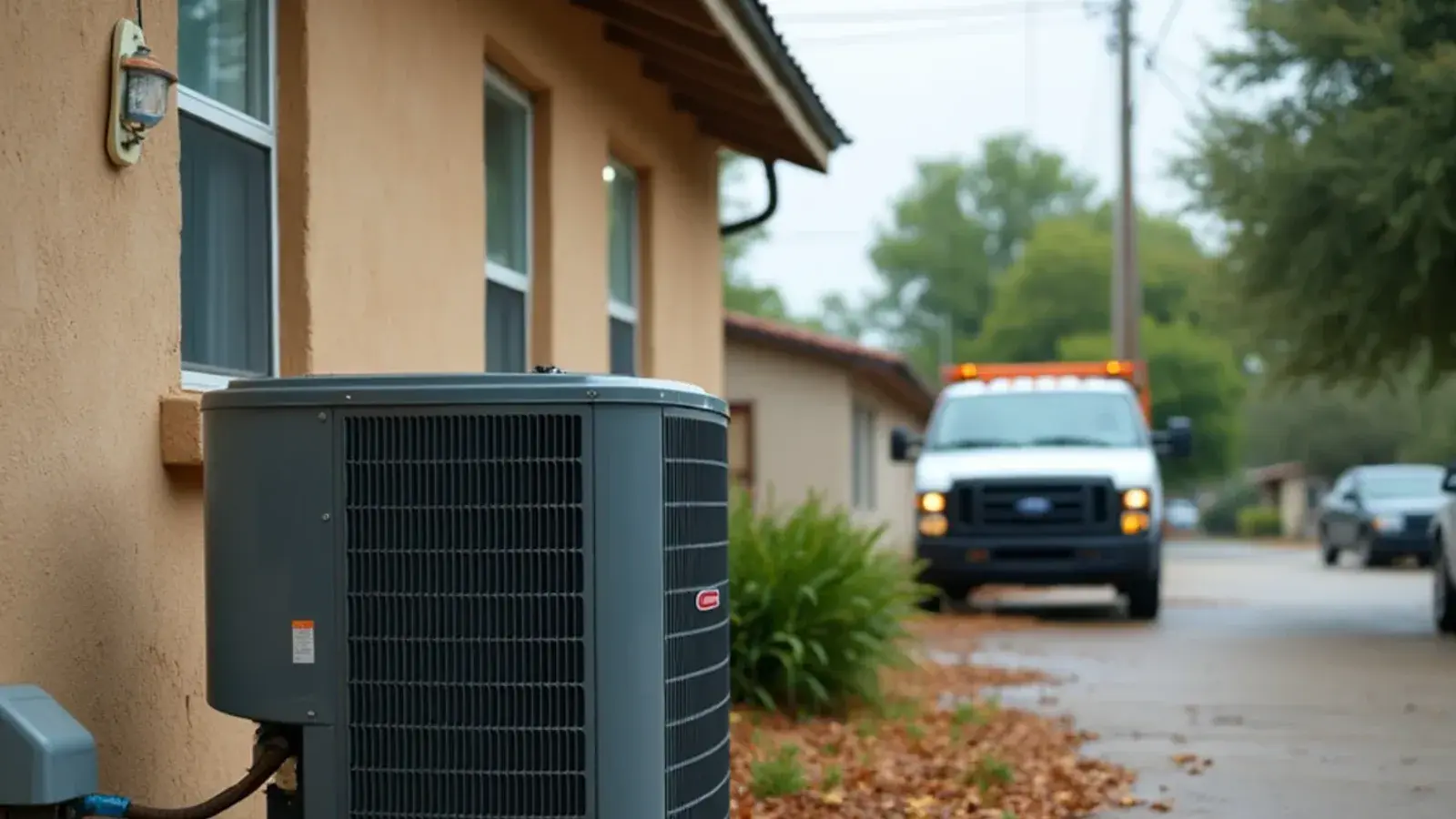
If your AC is not working after a power outage, set the thermostat to Off, wait until the lights hold steady, then pick Cool and give the compressor delay five to ten minutes. Still nothing? Check the thermostat settings, reset a tripped breaker once and confirm the outdoor disconnect. Floodwater, burning smells or repeat trips mean call a technician.
Resist the urge to flip every switch at once. Power coming back after a storm is often uneven, and the equipment has protections that make it look dead for a few minutes even when nothing is wrong. Work through the checks below in order. If you find signs of surge damage or floodwater, stop and get the system looked at before it runs.
Turn it off before the power returns
If you are still in the dark, set the thermostat to Off. When the grid comes back, voltage can dip and spike for a while, and a compressor trying to start into a brownout pulls heavy current. Wait until lights are steady for several minutes, then switch back to Cool.
This simple habit protects the most expensive part of the system. It also stops every home on the street from trying to start an AC at the same moment.
Give the delay timer a chance
Many thermostats and outdoor units have a built-in time delay, often a few minutes, that keeps the compressor from restarting too quickly. After an outage you may hear the indoor fan come on while the outdoor unit stays quiet. Wait five to ten minutes before assuming something has failed.
Some thermostats also show a flashing snowflake, a "wait" message or a clock icon during the delay. That is normal.
Restart checklist, step by step
Check the thermostat settings
Thermostats without a battery backup can lose their schedule, mode or set point. Confirm the mode is Cool, the temperature is set below the room, and Wi-Fi models have reconnected. If the screen is blank, replace the batteries first.
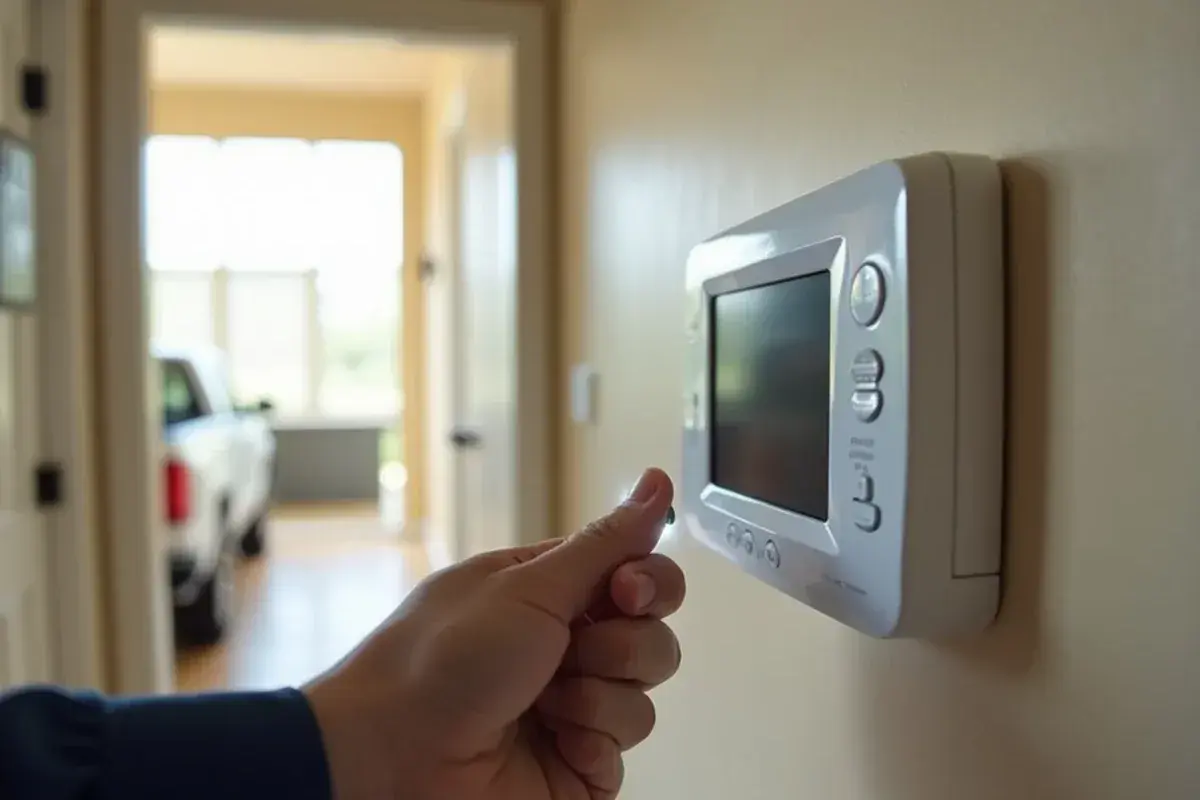
Look at the breaker panel
Find the breakers for the outdoor unit and the indoor air handler. A storm surge can trip them. If one is tripped, cycle it fully off and on a single time. Should it trip a second time, leave it alone. A breaker that will not hold is protecting you from a fault, and repeated resets can damage the wiring or start a fire.
Confirm the outdoor disconnect
That gray metal switch box mounted near the condenser should be fully closed with its pull-out block seated. Do not touch it if it is underwater, wet inside or shows scorch marks.
Inspect the indoor unit
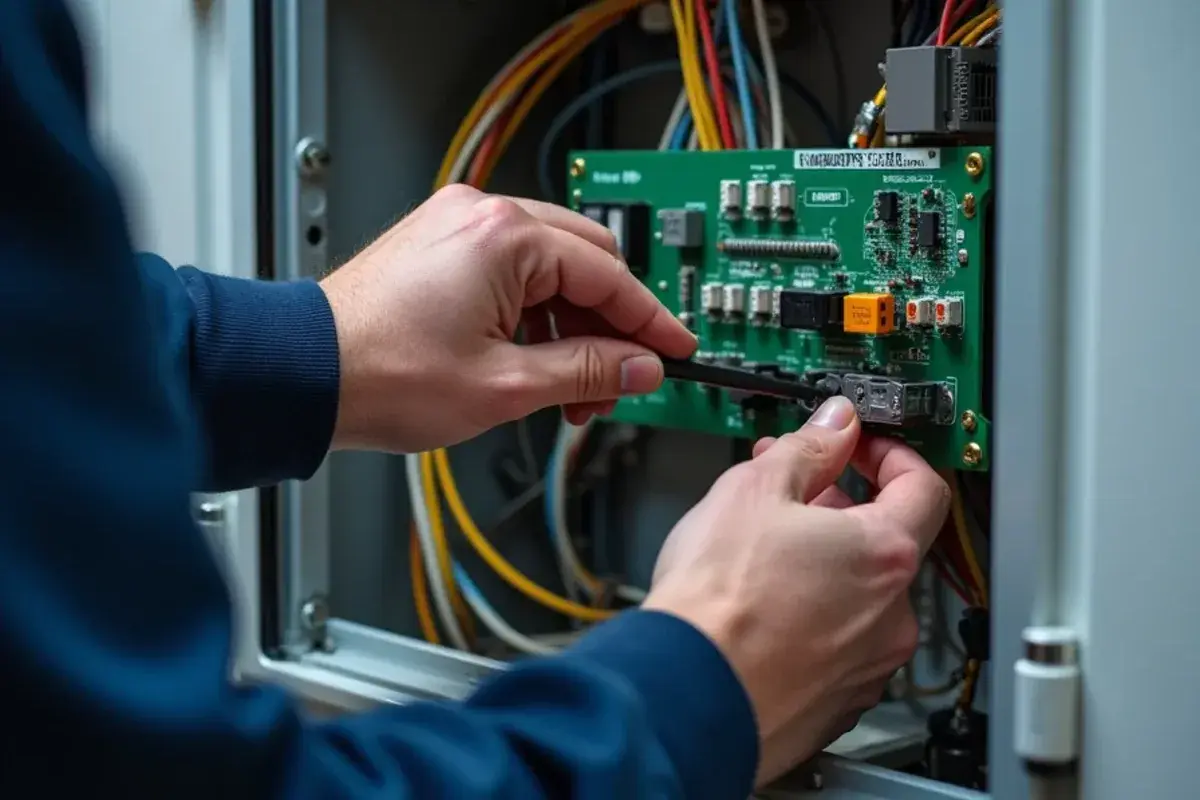
If the thermostat stays dark with good batteries and breakers on, the indoor unit may have blown its small low-voltage fuse on the control board, or the transformer may have failed. Replacing these involves opening an energized cabinet, so it is a job for a technician.
Mini-splits need their own restart
Many ductless units remember their last setting and start on their own once power returns, a feature often called auto-restart. Others drop back to standby and wait for the remote. Point the remote at the indoor head, press power, and set the mode and temperature again. If a light on the indoor unit is blinking in a pattern instead, write down the pattern or code; the surge may have tripped a protection on the outdoor board, which is a mini-split repair call rather than something to keep resetting.
Reading the signs after a storm
| What you find | What it often means | What to do |
|---|---|---|
| Indoor fan runs, outdoor unit quiet for a few minutes | Normal restart delay | Wait up to ten minutes |
| Thermostat blank, breakers on | Blown control fuse, failed transformer or float switch tripped | Call for diagnosis |
| Outdoor unit hums, fan does not spin | Capacitor weakened by the surge | Turn system off and call |
| Breaker trips again after one reset | Shorted part or compressor fault | Leave it off, call |
| Burning smell, buzzing or black marks | Surge or lightning damage | Shut off breakers, call right away |
| Mud line or debris on the condenser | Floodwater reached the unit | Do not restart until inspected |
When floodwater reached the outdoor unit
If water rose high enough to touch the condenser, do not turn it on, even after the yard dries. Water and silt can soak the wiring compartment, the fan motor windings and the compressor's electrical terminals. Running it can short components or trip the panel, and wet wiring is a shock risk.
A technician should open the unit, check the electrical parts for moisture and corrosion, test insulation on the compressor and fan motor, and clean mud out of the coil. Sometimes the unit can be dried and returned to service; sometimes parts or the whole condenser need replacing. Either way, the inspection comes first.
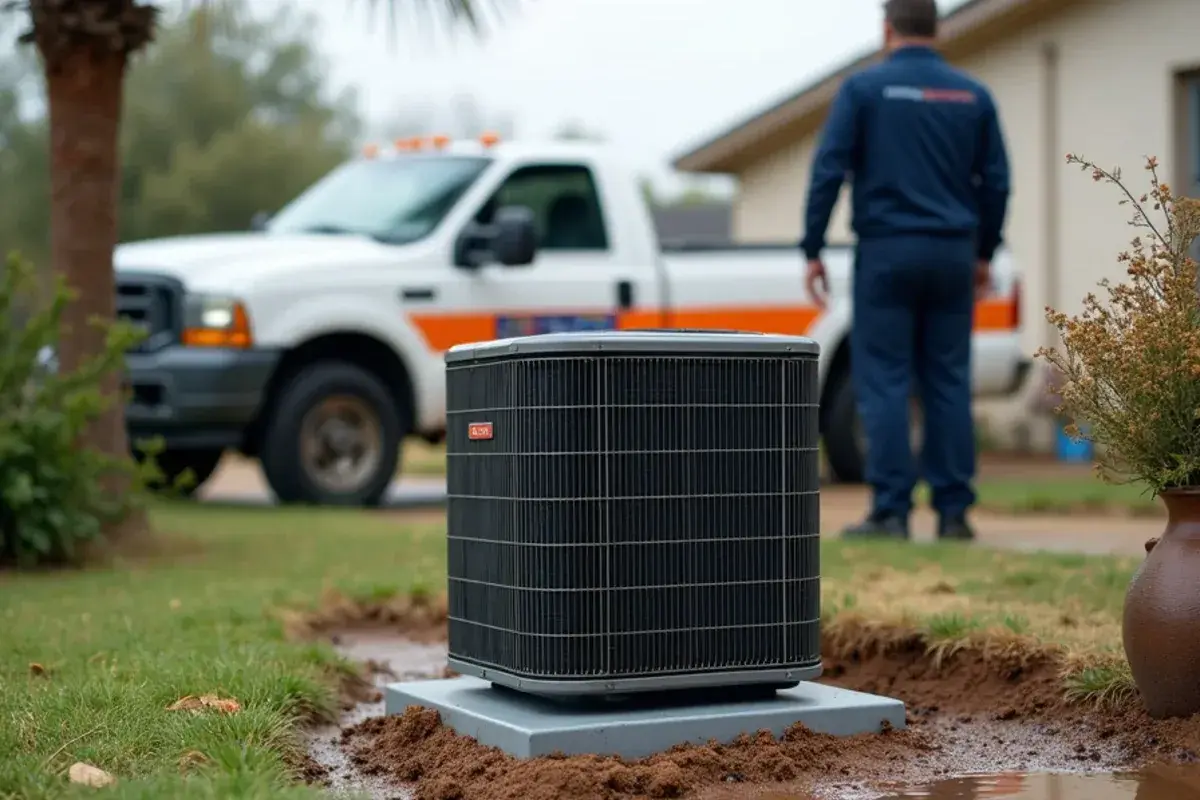
Homes on lower ground near the river feel this most. In El Refugio, which sits on lower ground between town and the river, heavy summer rain can pool around equipment that sits close to grade. Down in Palmview South, between US-83 and the river, the same low ground means raised pads and clear drain lines matter before storm season, not after.
Spotting surge and lightning damage
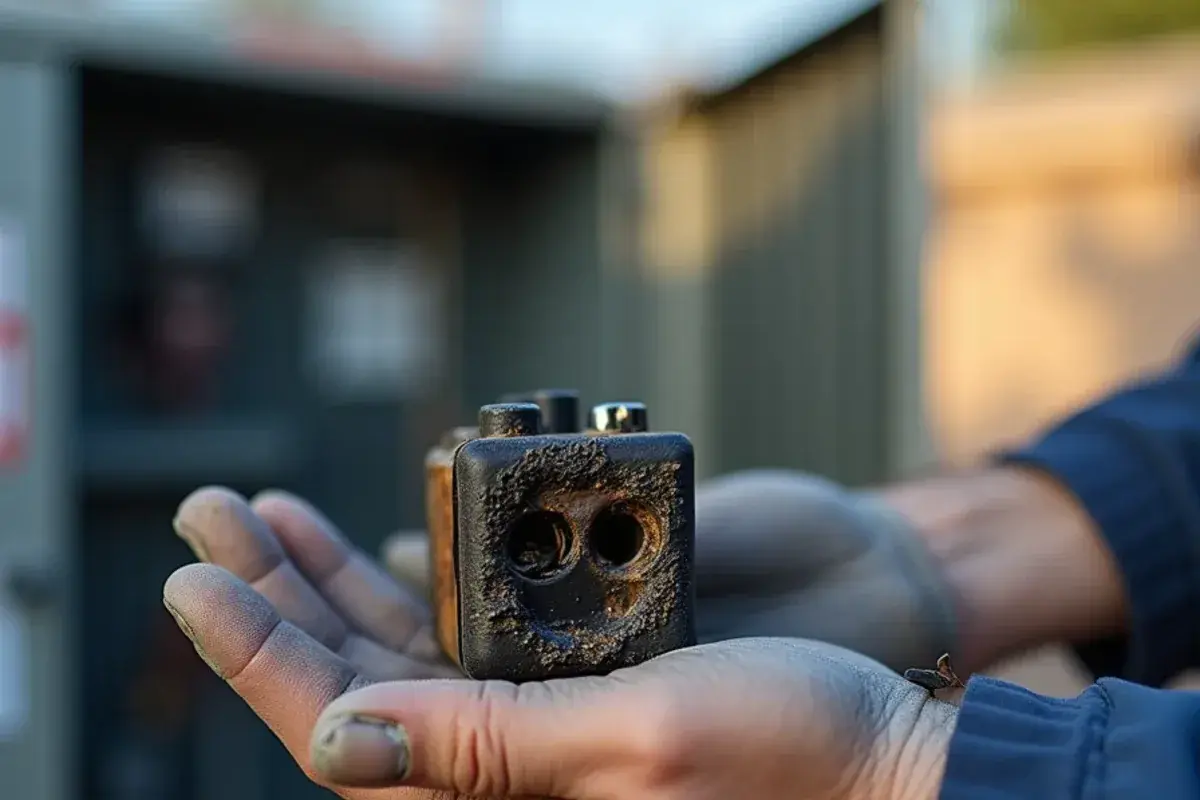
Lightning does not have to hit your house to hurt your AC. A nearby strike or a utility switching surge can travel through the lines and burn out a capacitor, contactor, control board or the compressor windings. The unit may die immediately, or it may limp along and fail a few days later.
Signs to watch for:
- A sharp electrical or burning smell from either unit
- Clicking without starting, or a loud buzz from the outdoor unit
- Lights dimming hard every time the AC tries to start
- Cooling that worked yesterday but is weak or intermittent today
Storm and power surge AC repair starts with testing each electrical part rather than guessing, because a surge often damages more than one component. If you plan to file an insurance claim, ask the technician to note the cause in writing and keep any damaged parts.
Generators and backup power
If you are running a portable generator, keep it outdoors, at least 20 feet from the house with the exhaust pointed away, as the U.S. Consumer Product Safety Commission advises. A porch or carport is too close, and open windows do not clear its carbon monoxide. Never plug a generator into a wall outlet to feed the house; this is called backfeeding and can injure utility workers. Most portable units are too small to start a central AC, so do not try unless the generator and a proper transfer switch were sized for it.
How a technician checks for surge damage, and what protection is worth it
Surge damage is rarely one part. A spike that cooks a capacitor often stresses the contactor and the control board on the same trip through the circuit, so a careful technician tests the whole electrical path instead of swapping the one part that looks burned.
- Line voltage at the disconnect, on both legs, to confirm the house is getting full, steady power and that the outage did not leave one leg weak.
- The 24-volt control circuit: the transformer output and the small fuse on the indoor board, which are the usual reasons a thermostat stays blank.
- Capacitor and contactor: a microfarad reading against the label, and the contact faces for pitting or welding.
- Motor and compressor windings: resistance between terminals and an insulation test to ground. A winding that reads fine at rest but leaks to ground can trip the breaker under load, which explains units that run for a minute and quit.
The honest trade-off is time. Replacing only the scorched contactor is quicker, but if the board or a winding also took a hit, the system can fail again within days, and a second visit costs more than testing it all the first time.
Surge protectors: what they can and cannot do
A surge protector mounted at the outdoor disconnect, or a whole-home device installed at the electrical panel by an electrician, clamps the spikes that come down the utility lines when power switches back on. Some HVAC models also hold the compressor off until voltage settles, which helps with the flicker that follows a storm. None of them can stop a direct lightning strike, and they wear out after absorbing big surges, so ask whether yours has an indicator light that shows it still works.
Getting cooling back the right way
Most outage problems turn out to be a tripped breaker, a lost thermostat setting or a short delay. If none of those fit, or if you see any sign of surge or flood damage, book an AC repair visit and describe exactly what you found. A careful restart today is far cheaper than a compressor that was forced to start into a fault. If the cooling still has not come back, call (213) 423-7827, tell us what the storm left behind and what the thermostat and outdoor unit are doing, and we will tell you what to leave switched off until a technician gets there.